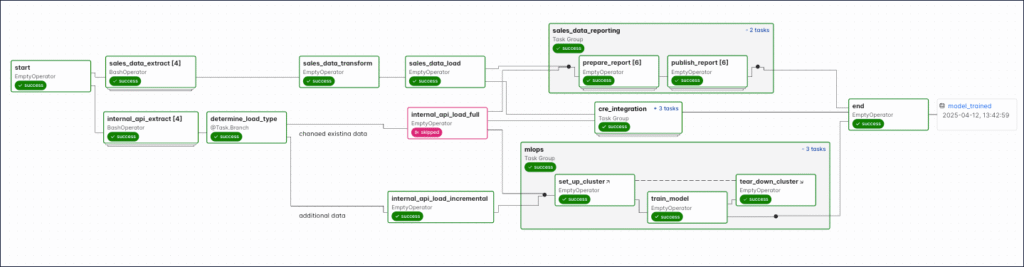

In today’s data-driven organizations, managing complex workflows—from ETL pipelines and ML model training to cloud infrastructure automation—requires a robust, scalable, and flexible orchestration tool. Apache Airflow has emerged as the leading open-source workflow automation platform, enabling engineers to author, schedule, and monitor workflows as code with ease.
This course is designed for data engineers, DevOps professionals, and data scientists who want to master Airflow’s core concepts, architecture, and best practices. Whether you’re automating data pipelines, coordinating tasks across distributed systems, or ensuring reliable workflow execution, Airflow provides the visibility, scalability, and extensibility needed for modern data orchestration.
What You Will Learn
By the end of this course, you will:
✅ Understand Airflow’s core components (DAGs, Operators, Tasks, Executors).
✅ Design, schedule, and monitor data pipelines using Python.
✅ Implement best practices for error handling, retries, and dependencies.
✅ Extend Airflow with custom Operators, Sensors, and Hooks.
✅ Deploy Airflow in production (Docker, Kubernetes, cloud services).
✅ Integrate Airflow with databases, cloud platforms (AWS/GCP/Azure), and big data tools.
Who Should Take This Course?
This course is ideal for:
- Data Engineers building and maintaining ETL/ELT pipelines.
- DevOps Engineers automating infrastructure workflows.
- ML Engineers orchestrating model training and deployment.
- Data Scientists scheduling data processing jobs.
- Platform Engineers managing workflow orchestration at scale.
Why Apache Airflow?
Airflow solves critical workflow automation challenges:
🔹 Workflow-as-Code – Define pipelines in Python (flexible & version-controlled).
🔹 Dynamic & Scalable – Handle complex dependencies and large-scale workflows.
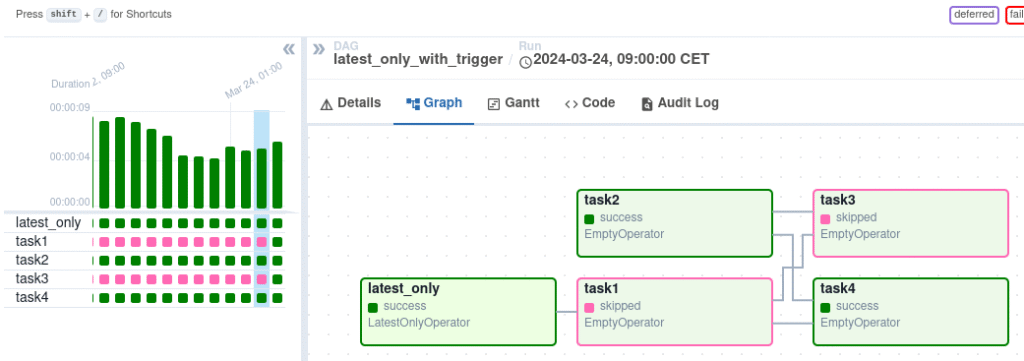
🔹 Rich UI & Monitoring – Track pipeline status, logs, and retries visually.
🔹 Extensible Ecosystem – 200+ integrations (Kubernetes, Snowflake, Spark, etc.).
🔹 Community & Adoption – Used by Airbnb, Twitter, PayPal, and more.
Prerequisites
To get the most out of this course, you should have:
- Basic Python programming knowledge.
- Familiarity with data pipelines (ETL/ELT) or scheduled jobs (cron).
- (Optional) Experience with containers (Docker) or cloud platforms (AWS/GCP/Azure).
Resources
- https://github.com/anilkulkarni87/airflow-docker
- https://github.com/apache/airflow/tree/main/chart
- https://github.com/guidok91/airflow