
the road
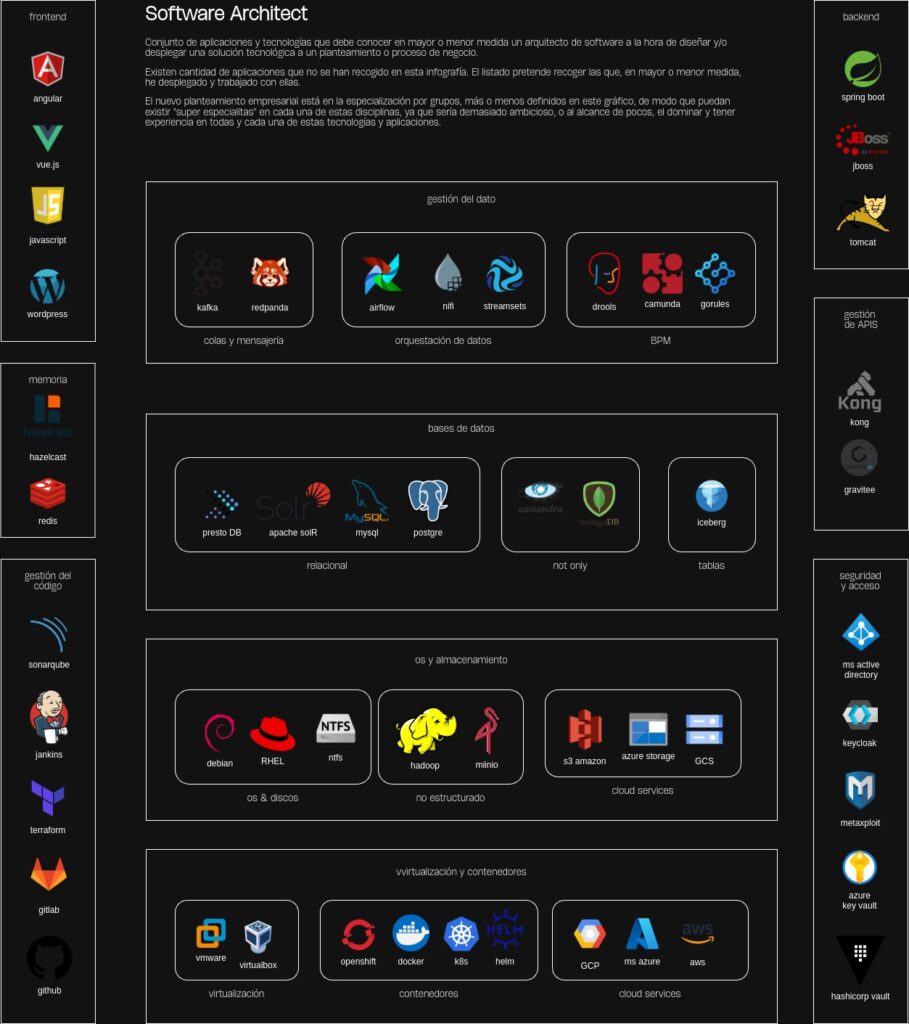
This is, in a sense, the roadmap for a software architect’s technologies and applications. From deploying virtual machines with Linux or Windows to securing any application or service in any public cloud.
Their grouping will help you identify or classify these applications and services based on their nature or use. At the bottom of the page, we provide a link where you can download this infographic on applications and services in software architecture.
services, tecnologies and applications.
Applications, technologies, and services in a single image, at a glance. This way, and grouped together, you can see these applications, technologies, and services based on their nature or use. While incomplete, as it would be a very dense work, they are intended to serve as a starting point for deploying applications and services reliably in any public cloud or on-premises.
Behind every application, cloud service, and distributed system lies a critical layer of abstraction: the operating system (OS) and virtualization technologies. These foundational components enable hardware efficiency, resource isolation, and scalable infrastructure—powering everything from legacy monoliths to cutting-edge cloud-native architectures.
This article explores how operating systems manage processes, memory, and I/O, while virtualization (from hypervisors to container-based isolation) revolutionizes resource utilization. We’ll compare Type-1 vs. Type-2 hypervisors, paravirtualization, and hardware-assisted virtualization, alongside their impact on performance and security. Additionally, we’ll examine the role of modern OS designs (e.g., microkernels, unikernels) in supporting lightweight virtualization for edge computing and serverless platforms.
Whether optimizing data center efficiency or designing embedded systems, understanding these principles is essential for architects and engineers. Let’s dissect the technologies that turn physical hardware into dynamic, scalable, and secure computing environments.
The rise of cloud-native applications has transformed how we build, deploy, and scale software. At the heart of this revolution are containers and orchestration platforms, enabling developers to package applications consistently and manage them efficiently across diverse environments. Docker, Kubernetes, and OpenShift have emerged as the cornerstone technologies driving this shift, each playing a critical role in modern infrastructure.
This article explores how Docker simplifies containerization, Kubernetes automates deployment and scaling, and OpenShift extends Kubernetes with enterprise-grade security and developer tools. We’ll examine their key features, use cases, and best practices—helping you choose the right tools for your architecture, whether you’re running microservices, CI/CD pipelines, or large-scale distributed systems.
By understanding these technologies, architects and DevOps teams can optimize resource utilization, improve scalability, and ensure high availability in today’s dynamic cloud environments. Let’s dive into the world of containers and orchestration—and how they power the future of software delivery
In today’s digital landscape, the ability to store, manage, and deliver data efficiently is the backbone of any successful software system. As applications scale to serve millions of users and handle ever-growing datasets, architects must make critical decisions around database design, caching, replication, and fault tolerance to ensure reliability, performance, and seamless availability.
This article dives into the core principles and best practices for designing robust storage and data management solutions in modern software architecture. We’ll explore key considerations such as SQL vs. NoSQL databases, distributed caching, sharding strategies, and high-availability patterns that keep systems resilient under load. Whether you’re building microservices, monolithic applications, or event-driven architectures, mastering these concepts is essential for creating scalable and fault-tolerant software.
Let’s examine the techniques and technologies that empower engineers to store data effectively, manage it intelligently, and guarantee its availability—even in the face of failures.
Software arquitect
A Software Architect is a strategic technologist who bridges business objectives with technical execution, designing systems that are scalable, resilient, and adaptable to ever-changing demands. Unlike traditional roles focused solely on diagrams and patterns, today’s architect is a polyglot problem-solver, fluent in cloud-native principles, distributed systems, and DevOps practices—while balancing trade-offs between speed, cost, and quality.
Key Responsibilities of a 2024 Software Architect:
System Design Leadership: Craft blueprints for modular, observable, and maintainable systems (e.g., microservices, event-driven architectures).
Technology Agnosticism: Select tools (languages, databases, infra) based on context—not trends—weighing trade-offs like vendor lock-in vs. innovation.
Cross-Functional Collaboration: Align stakeholders (engineers, product, security) to ensure technical decisions support business KPIs.
Evolutionary Architecture: Design for incremental change via patterns like Strangler Fig or feature flags, avoiding premature optimization.
Sustainability & Cost Awareness: Optimize for cloud efficiency (FinOps), carbon footprint, and long-term operability.
Shifts from the Past:
From rigid “ivory tower” designs → To iterative, feedback-driven architecture (e.g., architecture decision records).
From monolithic standardization → To purposeful heterogeneity (e.g., polyglot persistence).
From infrastructure gatekeeping → To enabling self-service platforms (e.g., internal developer portals).
In essence, the modern architect is less a “builder of castles” and more a gardener of systems—cultivating growth, pruning complexity, and ensuring the ecosystem thrives amid chaos.
Optional Add-ons:
Skills Radar: Highlight demand for skills like AI/ML integration, platform engineering, or quantum computing readiness.
Metrics: How architects measure success (e.g., MTTR, cost-per-transaction, deployment frequency).